What wearables proved, and what they missed
Ray-Ban Meta, the Humane AI Pin and Vision Pro are the first honest test bench for a framework written in 2006. Two of its three premises hold. The third one — that invisibility is a design outcome — does not.
My thesis argued that computing would become environmental: sensed, contextual, and answerable to the person standing in front of it. Twenty years later the hardware exists. It arrived not because anyone followed the argument, but because transistor density, cheap sensor fusion and on-device inference converged at the same time.
The engine, and the point where density stopped being the metric
Moore's 1965 prediction bought the miniaturisation these devices run on. What matters now is what replaced it. Density gains slowed; packaging and architecture took over — 3D stacking such as Intel's Foveros, gate-all-around transistors, heterogeneous integration. The industry stopped optimising transistors per die and started optimising computation per joule, under the banner of more than Moore.
That shift is the whole reason a wearable is possible. Desktop-class inference inside a sub-10-watt thermal envelope is a power-budget achievement, not a lithography one. Three things it bought directly:
- On-device inference — the M2 in Vision Pro runs diffusion transformers locally at around 350mW.
- Sensor fusion — Ray-Ban Meta processes a 12MP camera and spatial audio in real time.
- Energy efficiency — successive Snapdragon generations cut power per operation by roughly 40%.
Prolegomena To Any Future Device Physics makes the sharper version of the argument: transistor density stopped being the useful figure of merit, and the field moved to computational efficiency per joule. None of this was in reach in 2006, and none of it came from the axis everyone was watching.
Ray-Ban Meta: the contextual promise, and the bystander bill

The glasses are the closest thing yet to the environmental memory I described. Ask about what is in front of you and the answer arrives with the surroundings already in the prompt. That is anticipation, and it works.
The cost lands on someone who never agreed to it. The recording indicator is a small LED, and voice-data retention policy stays with the manufacturer:
The LED recording indicator is nearly imperceptible… you'll look stylish, but bystanders won't know they're being filmed.
A reviewer, on Ray-Ban Meta
This mirrors what my own 2005 Wi-Fi fieldwork found in a smaller form: users consistently underestimated how uncomfortable their instrumentation made other people. Short-range channels that only work on skin contact — human body communication at roughly a tenth of Wi-Fi's power — are one of the few technical answers that reduce the blast radius instead of asking for more consent screens.
Humane AI Pin: privacy by design, inequity by accident
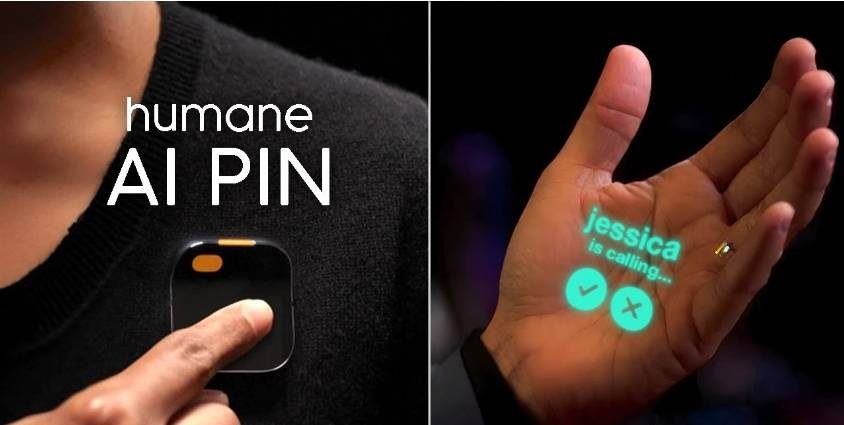
The Pin got the privacy architecture right. A single-diode laser projects a 720p display onto the palm rather than lighting a screen for the room, drawing about 1.2W; a hardware Trust Light indicates when sensors are live. That is a dynamic, legible permission model built into the object, and flexible memristors are part of what makes the power budget work.
It also priced itself at $699 plus a subscription, which is the part my framework never modelled. A technology described as ubiquitous that costs a month of median rent is not ubiquitous; it is a segment. PEAF: Learnable Power Efficient Analog Acoustic Features argues analog signal processing could cut that bill of materials by around 60% by avoiding power-hungry converters. The research exists; adoption does not follow, because nothing in the market rewards it.
Vision Pro: contextual permission, then physics

Vision Pro implements contextual permission almost to the letter: Optic ID keeps biometric templates in a secure enclave, and gaze data drives interaction without being handed to the application. The M2's 16-core Neural Engine drives 23 million pixels in real time, at an efficiency that would have read as fiction in 2006.
Then it weighs 650 grams and sits on your face. Weiser's premise was that the most profound technologies disappear. A device you are continuously aware of wearing has not disappeared, and no amount of process node fixes that. Ergonomics is a separate discipline with its own limits, and my framework treated it as a footnote.
What AI actually changed
Three software shifts did more for the 2006 model than any single sensor:
- Federated and on-device learning removed the assumption that personalisation requires a round trip to a server.
- Compressed vision and diffusion models made local inference cheap enough to run continuously.
- Event-driven, neuromorphic-style sensing made always-on plausible without always-on power.
Together they moved wearables from collection to participation: the device proposes rather than logs. Work on machine learning in wearables frames the same shift as the move from data collector to proactive partner. That is the part of the thesis I would defend unchanged.
Two premises survive: context is the interface, and privacy has to be architectural rather than contractual. The one I would rewrite is invisibility. I treated it as something that follows from good design. It is a physical property — of weight, heat, battery and price — and it is where these devices are still losing.